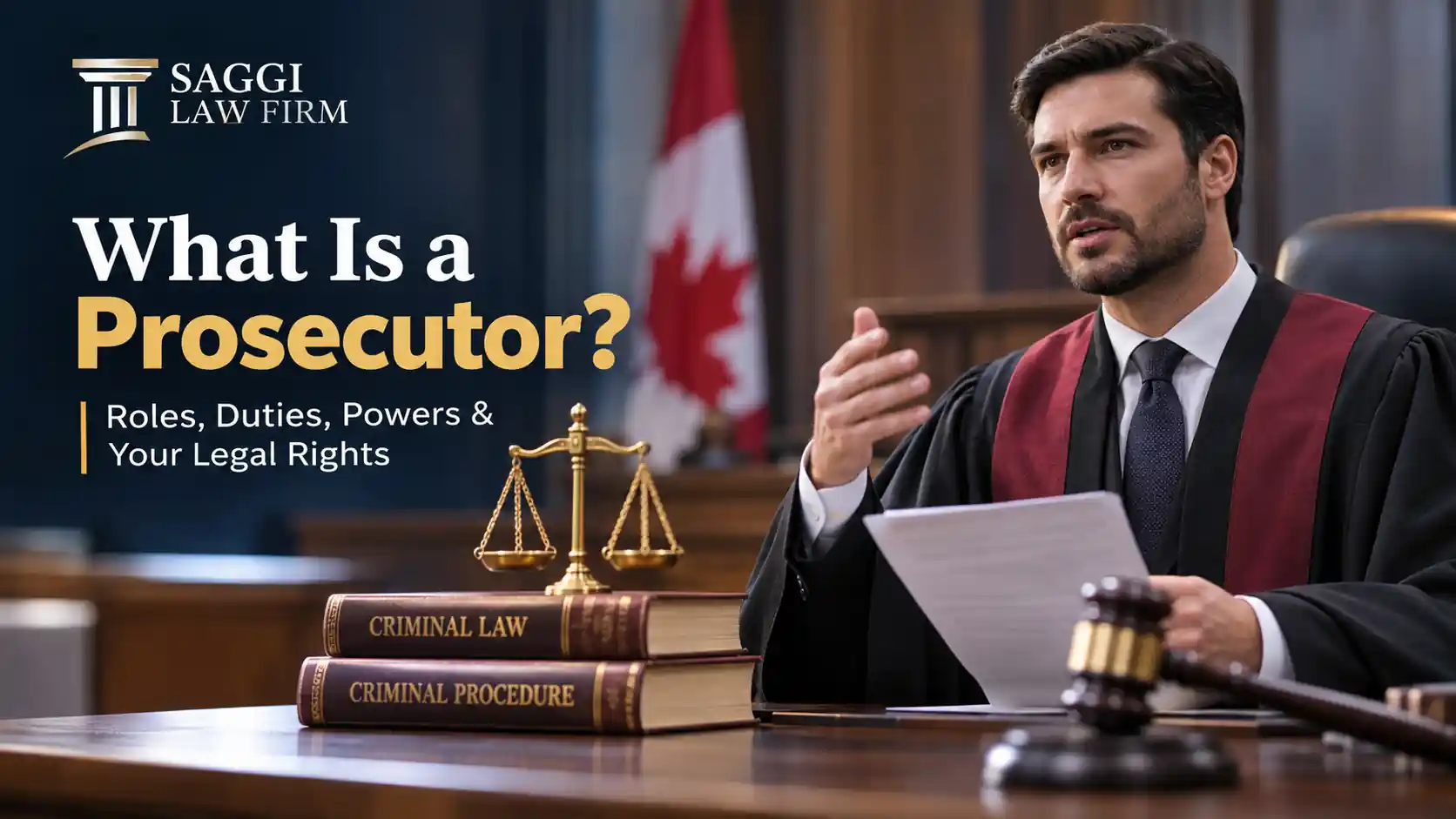
What Is a Prosecutor? Roles, Responsibilities, Powers, and Legal Rights
When someone is accused of committing a crime, a prosecutor plays an important role in the criminal justice system. Prosecutors are responsible for presenting criminal cases on behalf of the state or government, evaluating evidence, and helping ensure that criminal proceedings are conducted fairly and lawfully. Their decisions can influence whether criminal charges are filed, how a case proceeds, and what happens during a criminal trial.
Understanding what a prosecutor is, what powers they have, and how they differ from defence lawyers can help you better understand your legal rights if you are facing criminal allegations.
At Saggi Law Firm, we understand that criminal charges can create uncertainty and serious concerns about your future. Knowing the role of the prosecution and having experienced legal representation can help you make informed decisions throughout your case.
What Is a Prosecutor?
A prosecutor is a government-appointed or authorized legal professional responsible for presenting criminal cases against individuals accused of breaking the law. A prosecutor represents the interests of the state or public, rather than acting as the personal lawyer of the victim.
The prosecutor’s primary responsibility is to assess available evidence, determine whether criminal charges should proceed, and present the prosecution’s case before a criminal court.
Prosecutor Definition and Meaning
The prosecutor definition refers to a lawyer or legal official who conducts criminal proceedings on behalf of the government or prosecution authority.
In simple terms, a prosecutor is the legal professional responsible for trying to prove that an accused person committed an offence.
The prosecutor meaning can vary depending on the legal system. For example:
Public prosecutor: A legal professional who represents the public or government in criminal cases.
Crown prosecutor: A prosecutor who represents the Crown in jurisdictions such as Canada.
State prosecutor: A government lawyer responsible for prosecuting offences under state law.
Federal prosecutor: A lawyer responsible for prosecuting offences under federal law.
District attorney (DA): An elected or appointed official who oversees criminal prosecutions in certain jurisdictions, particularly in the United States.
Although their titles differ, these professionals generally perform similar functions within their respective criminal justice systems.
What Does a Prosecutor Do?
The role of a prosecutor extends beyond presenting arguments in court. Prosecutors participate in different stages of criminal proceedings, from reviewing police investigations to presenting evidence and making sentencing recommendations.
Their main objective is to pursue criminal cases fairly while respecting the rights of the accused person.
1. Reviewing Criminal Investigations
A prosecutor may review information gathered during a police investigation, including:
Police reports and investigation records.
Witness statements and testimony.
Physical and forensic evidence.
CCTV footage and photographs.
Digital communications and electronic records.
Expert reports and medical documentation.
This evidence collection and evaluation process helps determine whether sufficient admissible evidence exists to support criminal charges.
2. Making Charging Decisions
One of the important duties and responsibilities of a prosecutor is making charging decisions.
Depending on the jurisdiction, prosecutors may decide whether to proceed with criminal charges, request additional investigation, or discontinue a prosecution.
They consider factors such as:
Whether sufficient evidence exists.
Whether the evidence is legally admissible.
Whether the prosecution has a reasonable prospect of success.
Whether pursuing the case serves the public interest.
Prosecutorial discretion allows prosecutors to make certain decisions independently, subject to applicable laws and legal oversight.
3. Presenting Evidence in Court
During a criminal trial, the prosecutor presents the prosecution’s case by introducing relevant evidence and questioning witnesses.
Their courtroom responsibilities may include:
Delivering opening statements.
Conducting direct examination of witnesses.
Cross-examining defence witnesses.
Presenting physical and documentary evidence.
Making legal arguments.
Delivering closing arguments.
The prosecution must establish the defendant’s guilt according to the applicable standard of proof.
4. Negotiating Plea Agreements
Prosecutors may participate in plea negotiations with defence lawyers.
A plea bargain or plea agreement generally involves an accused person agreeing to plead guilty to an offence, sometimes in exchange for an agreed recommendation or other concession, depending on the jurisdiction.
However, plea arrangements must comply with applicable legal procedures, and judicial approval may be required.
5. Making Sentencing Recommendations
If an accused person is convicted, the prosecutor may make sentencing recommendations to the court.
These recommendations can consider:
The seriousness of the offence.
The circumstances surrounding the crime.
Previous criminal convictions.
Harm caused to victims.
Relevant sentencing guidelines.
Aggravating and mitigating factors.
The judge ultimately determines the sentence under the applicable law.
What Are the Duties and Responsibilities of a Prosecutor?
A prosecutor has significant legal responsibilities and must act professionally, fairly, and ethically.
Their duties generally include:
Evaluating evidence before pursuing criminal charges.
Presenting admissible evidence during criminal proceedings.
Respecting the presumption of innocence.
Disclosing relevant evidence to the defence as required by law.
Avoiding conflicts of interest.
Protecting the integrity of criminal proceedings.
Respecting the legal rights of defendants.
Presenting relevant information to the court.
Avoiding misleading statements or improper courtroom conduct.
Acting in the public interest.
Ethical Duties and Prosecutorial Misconduct
Prosecutors must follow applicable professional standards and ethical obligations.
Prosecutorial misconduct occurs when a prosecutor engages in improper conduct that violates legal or professional responsibilities.
Examples may include:
Withholding material exculpatory evidence.
Knowingly presenting false evidence.
Improperly influencing witnesses.
Making misleading statements to the court.
Engaging in discriminatory prosecution.
Violating disclosure obligations.
In some legal systems, disclosure obligations include principles associated with Brady disclosure, which requires prosecutors to disclose material favourable evidence to the defence.
Such misconduct can affect the fairness of criminal proceedings and may lead to legal remedies, depending on the circumstances.
Prosecutor vs Defence Attorney vs Judge: What Is the Difference?
Understanding the difference between a prosecutor, defence attorney, and judge is important when navigating a criminal case.
| Legal professional | Main responsibility |
|---|---|
| Prosecutor | Presents the criminal case on behalf of the state. |
| Defence attorney | Represents and protects the accused person’s legal interests. |
| Judge | Oversees proceedings, interprets the law, and makes judicial decisions. |
Prosecutor vs Defence Lawyer
A prosecutor works to establish the prosecution’s case, while a defence lawyer challenges the allegations and protects the defendant’s rights.
A defence attorney may:
Examine the prosecution’s evidence.
Challenge unreliable witness testimony.
Identify procedural violations.
Dispute the admissibility of evidence.
Negotiate plea agreements.
Present legal arguments.
Seek dismissal of charges where legally justified.
Both legal professionals have important roles in maintaining a fair criminal justice system.
Prosecutor vs District Attorney
The terms prosecutor and district attorney are closely related but are not identical.
A prosecutor is a general term for a legal professional who conducts criminal prosecutions. A district attorney is an official responsible for overseeing prosecutions within a particular district in certain legal systems.
A district attorney may supervise assistant district attorneys and deputy district attorneys.
Prosecutor vs Judge
A prosecutor represents the state’s interests during criminal proceedings, whereas a judge must remain impartial.
The prosecutor presents arguments and evidence, while the judge makes decisions about legal issues, trial procedures, and, where applicable, guilt and sentencing.
What Powers Does a Prosecutor Have?
A prosecutor may have several legal powers depending on the jurisdiction and the applicable criminal procedure laws.
These can include:
Reviewing police investigation files.
Deciding whether to initiate or continue prosecutions.
Filing or approving criminal charges where authorized.
Presenting evidence in court.
Questioning witnesses.
Participating in plea negotiations.
Making sentencing recommendations.
Appealing certain court decisions.
However, prosecutorial authority is not unlimited.
A prosecutor cannot independently determine guilt, impose a criminal sentence, or disregard the defendant’s legal rights. These matters are governed by the courts and applicable legislation.
Can a Prosecutor Investigate a Crime?
Prosecutors generally review and assess criminal investigations conducted by law enforcement agencies. In some jurisdictions, they can request further investigation, provide legal guidance, or exercise specific investigative powers.
However, their investigative authority varies according to the legal system.
What Happens When a Prosecutor Files Criminal Charges?
When criminal charges are filed, the accused person enters the criminal justice process.
Although procedures differ between jurisdictions, a criminal case may involve the following stages:
Criminal investigation
Law enforcement investigates the alleged offence and collects relevant evidence.
Charging decision
The prosecution reviews the available evidence and determines whether charges should proceed.
Arrest and arraignment
Depending on the circumstances, the accused may be arrested, formally informed of the charges, and brought before a court.
Bail hearing
The court considers whether the accused should be released while the criminal case continues.
Pre-trial proceedings
The prosecution and defence address disclosure, legal applications, and other procedural matters.
Criminal trial
Both sides present their arguments and relevant evidence.
Verdict and sentencing
The court determines the outcome. If the defendant is convicted, sentencing follows.
Depending on the case, the outcome may be a criminal conviction, acquittal, dismissal of charges, or another legally recognized resolution.
What Is the Burden of Proof for a Prosecutor?
The burden of proof refers to the legal responsibility to establish the allegations presented in a criminal case.
In many common-law criminal justice systems, the prosecution must prove the defendant’s guilt beyond a reasonable doubt.
This is a high standard of proof designed to protect individuals from wrongful convictions.
Presumption of Innocence
The presumption of innocence means that an accused person is considered innocent unless and until guilt is established through the applicable legal process.
A defendant does not generally have to prove their innocence.
The prosecution must establish the required elements of the alleged offence using legally admissible evidence.
What Happens If the Prosecutor Has Insufficient Evidence?
If the prosecution does not have sufficient evidence to establish the allegations, several outcomes may be possible:
Criminal charges may not be filed.
The prosecution may discontinue the case.
The court may dismiss certain charges.
The defendant may be acquitted following trial.
The appropriate outcome depends on the available evidence, procedural stage, and applicable law.
Does a Prosecutor Represent the Victim?
No. A prosecutor generally represents the state or public interest, not the victim personally.
Although prosecutors may consider victims’ interests, explain court proceedings, and present relevant victim evidence, they do not normally act as the victim’s personal legal representative.
Victim rights and advocacy provisions vary by jurisdiction. A victim may need separate legal advice for certain personal legal matters.
What Is the Difference Between Felony and Misdemeanor Prosecution?
Criminal prosecution can involve different categories of offences.
In jurisdictions that use these classifications:
Felony prosecution: Generally involves more serious criminal offences that may carry substantial prison sentences.
Misdemeanor prosecution: Generally involves less serious offences with comparatively lower potential penalties.
Other jurisdictions use different classifications, such as summary and indictable offences.
For example, Canada distinguishes between summary conviction offences, indictable offences, and hybrid offences under its criminal law.
The prosecution procedures and potential penalties depend on the specific offence and jurisdiction.
How to Become a Prosecutor?
Becoming a prosecutor generally requires a legal education, professional qualifications, and authorization to practise law.
Typical requirements include:
Education and Qualifications
Completing the required legal education.
Obtaining the necessary professional qualifications.
Meeting licensing or admission requirements.
Developing knowledge of criminal law and criminal procedure.
Gaining practical legal experience.
Prosecutor Career Path
A legal professional may begin as a junior prosecutor or assistant prosecutor before progressing to senior prosecution positions.
Potential roles include assistant district attorney, deputy district attorney, public prosecutor, senior prosecutor, and chief prosecutor.
Requirements, career opportunities, and prosecutor salary vary significantly by country and legal jurisdiction.
When Should You Contact a Criminal Defence Lawyer?
Facing criminal charges can have serious consequences for your employment, reputation, finances, and personal freedom.
You should consider obtaining legal advice if:
You have been arrested or charged with a criminal offence.
You have received a court summons.
You are under investigation by law enforcement.
You believe the prosecution has misunderstood or misrepresented evidence.
You suspect evidence has been improperly collected or withheld.
You are being pressured to accept a plea agreement.
You believe your legal rights have been violated.
You need advice about a criminal trial or appeal.
An experienced criminal defence lawyer can review the allegations, assess the prosecution’s evidence, identify potential legal issues, and explain your available options.
How Saggi Law Firm Can Help
At Saggi Law Firm, we understand the importance of protecting your rights when dealing with criminal allegations.
Our legal approach focuses on understanding the circumstances of your case, examining the available evidence, identifying weaknesses in the prosecution’s arguments, and developing an appropriate legal strategy.
Whether you are facing criminal charges, responding to an investigation, or preparing for court proceedings, obtaining timely legal advice can make a meaningful difference.
Do not assume that being charged means you will be convicted. You have legal rights, and the prosecution must meet its burden of proof.
Contact Saggi Law Firm to discuss your circumstances and understand how our criminal defence legal services may help protect your interests.
Frequently Asked Questions About Prosecutors
1. Who Is a Prosecutor in a Criminal Case?
A prosecutor is a legal professional who represents the state or government in criminal proceedings and presents evidence against an accused person.
2. Can a Prosecutor Drop Criminal Charges?
Depending on the jurisdiction, a prosecutor may discontinue or withdraw charges when legally justified. In some cases, court approval is required.
3. Does a Prosecutor Work for the Government?
Yes. Public prosecutors generally work for government prosecution services or other authorized public legal institutions.
4. Can a Prosecutor Decide Whether to File Charges?
In many jurisdictions, prosecutors have authority to make charging decisions based on available evidence, applicable laws, and public interest considerations.
5. What Rights Does a Defendant Have Against a Prosecutor?
Defendants generally have rights to legal representation, a fair trial, the presumption of innocence, disclosure of relevant evidence, and protection against unlawful treatment, subject to the applicable jurisdiction.
6. Can a Prosecutor Recommend Jail Time?
Yes. A prosecutor may recommend a particular sentence following conviction, but the judge makes the final sentencing decision.
7. What Is the Role of a Prosecutor in the Criminal Justice System?
A prosecutor helps enforce criminal law by reviewing evidence, pursuing appropriate criminal charges, presenting cases in court, and ensuring that criminal proceedings comply with legal and ethical obligations.