★★★★★Bail Hearings Toronto | Lawyer · Criminal Defence

Saggi Law Firm — Criminal Defence

Attestation Services in Canada | Document Attestation, Authentication & Apostille

When Canadian documents need to be used outside Canada, the receiving country or organization may require authentication, an apostille, legalization, or another form of document verification. Saggi Law Firm provides attestation services to help individuals and businesses prepare documents for international use, including certificates, powers of attorney, commercial documents, educational records, and other official documents.

The appropriate process depends on the type of document, where it was issued or notarized, and the country where it will be presented. Since Canada joined the Hague Apostille Convention on January 11, 2024, many Canadian documents destined for participating countries can now receive an apostille rather than going through the former multi-step authentication and legalization process.

The right authentication or attestation process can help prevent delays when your documents are needed abroad.

Practicing Since2013
Availability24/7
ConsultationFree

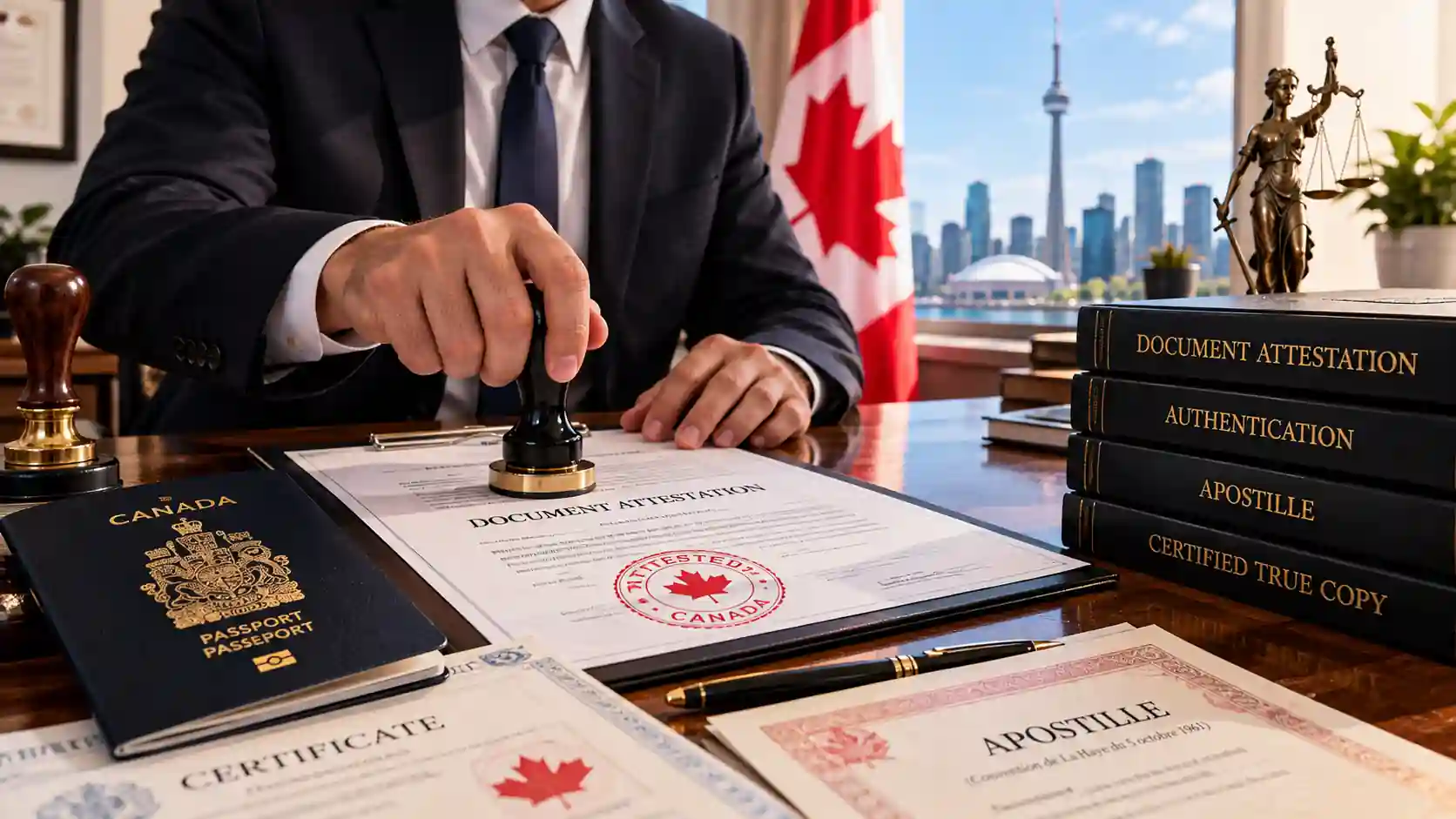
A polished, photorealistic legal office scene representing professional attestation and document authentication services in Canada. A legal professional is stamping an official document on a refined wooden desk surrounded by certificates, a Canadian passport, apostille paperwork, legal folders, and authentication materials. A Canadian flag, Lady Justice statue, and Toronto skyline with the CN Tower appear in the background. The warm natural lighting and premium composition convey trust, professionalism, and attention to detail, making the image suitable for an Attestation Services in Canada | Document Attestation, Authentication & Apostille webpage.

Overview

What Attestation Means Under Canadian Law

Document attestation generally refers to a process used to verify the authenticity of a signature, seal, or official capacity associated with a document. In Ontario, Official Documents Services verifies signatures and seals against records and may issue either a certificate of authentication or an apostille, depending on the destination and applicable requirements.

An apostille is used for Canadian public documents destined for countries that participate in the Hague Apostille Convention. Canada became a party to the Convention on January 11, 2024. For documents going to Hague Convention countries, an apostille may replace additional legalization at an embassy or consulate, although the final recipient's requirements should always be confirmed.

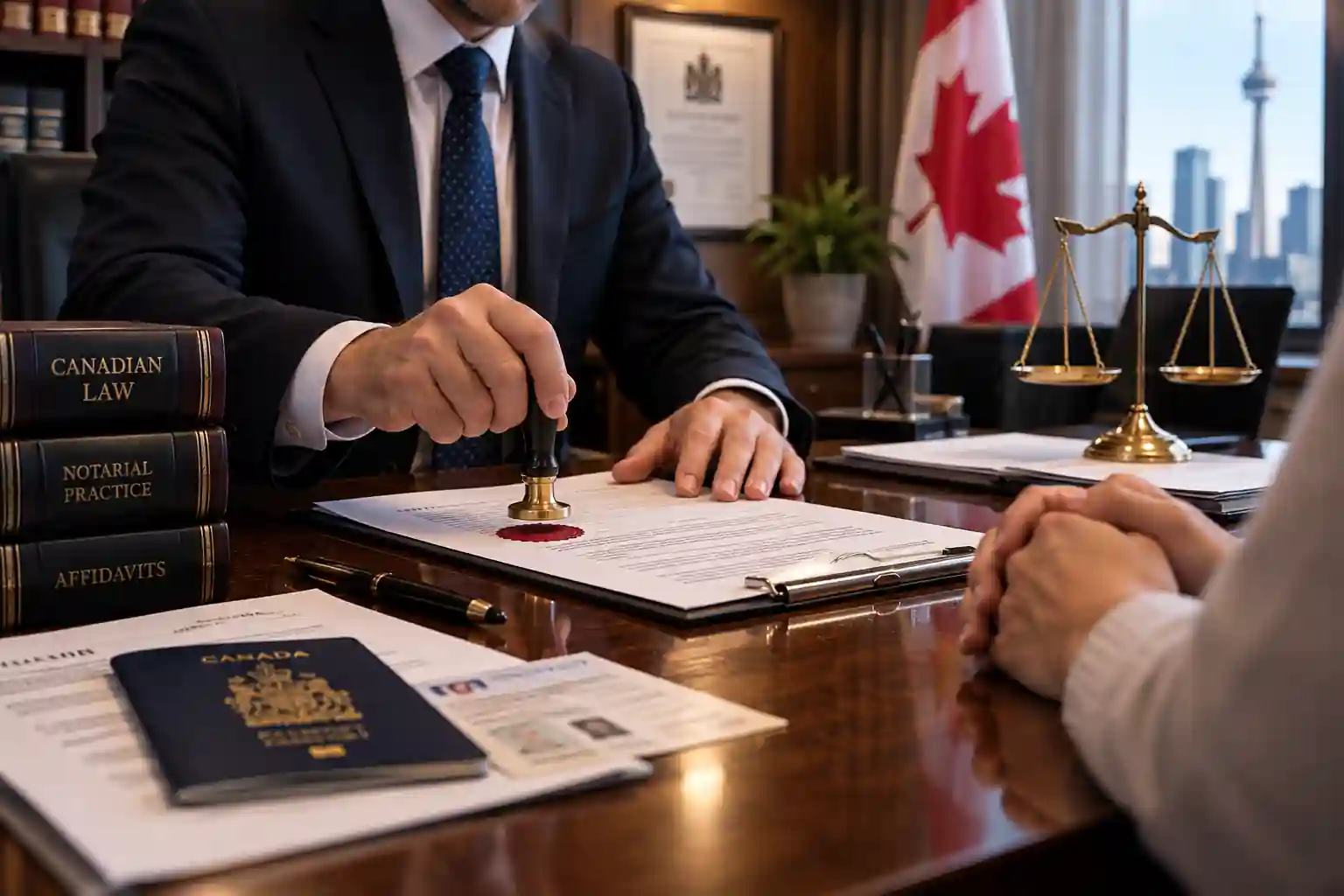
A cinematic, photorealistic Canadian legal office scene showing a lawyer or notary formally attesting an official document with a traditional seal. A client sits across the polished wooden desk, with legal documents, a Canadian passport, law books, scales of justice, and a Canadian flag visible in the background. Warm antique-gold lighting and deep navy shadows create a professional, trustworthy atmosphere suited to explaining attestation under Canadian law.

What It Involves

What a Document Attestation Request Can Involve

A document attestation request can involve many types of personal, educational, commercial, and official documents. Examples can include birth certificates, marriage certificates, degrees, diplomas, transcripts, powers of attorney, corporate documents, business records, court documents, and other public or notarized documents.

The requirements are not identical for every document. Some Ontario-issued documents may be eligible for direct authentication without prior notarization, while other documents require notarization before authentication. Documents issued outside Canada generally cannot simply be authenticated by Ontario's Official Documents Services, although specific notarization circumstances can create exceptions.

How We Help

Apostille or Authentication

The destination country determines whether an apostille or another authentication process is appropriate. Documents issued or notarized in Ontario are generally handled through Ontario's competent authority for apostille purposes, while certain federal documents and documents from other provinces or territories may fall under Global Affairs Canada's jurisdiction.

Consulate and Embassy Requirements

An apostille does not necessarily answer every requirement imposed by a receiving authority. Some countries that are not parties to the Hague Apostille Convention may require authentication followed by legalization through their embassy or consulate. The destination authority should therefore be contacted before documents are submitted.

Saggi Law Firm office in Brampton, Ontario
★Est. 2013 · Brampton, ON

“A direct 24/7 line, personal attention, and a strategy built around your case — not a template.”

— Mandeep Saggi

Our Approach

Building an Effective Document Attestation Strategy

A successful certificate attestation process starts with understanding where the document was issued, where it will be used, what the receiving organization requires, and which authority has jurisdiction over authentication. Preparing the correct documents before submission can reduce avoidable delays and additional processing.

  • Destination Requirements — whether the receiving country, embassy, consulate, university, employer, or other organization requires an apostille, authentication, legalization, or another form of verification.
  • Document Eligibility — whether the specific document qualifies for authentication and whether notarization, translation, reissuance, or other preparation is required.
  • Issuing Authority — whether the document was issued or notarized in Ontario, another Canadian province, or by the Government of Canada and therefore falls under the appropriate authentication authority.
  • Final Use — whether the document is being prepared for employment, education, immigration, marriage, business, powers of attorney, or another purpose outside Canada.

Meet the Lawyer

Meet the Lawyer

Your legal matter deserves personal attention from a qualified legal professional. Mandeep Saggi represents clients through Saggi Law Firm in serious criminal matters and provides focused criminal defence representation.

Mandeep Saggi, Criminal Defence Lawyer at Saggi Law Firm in Brampton, serving Toronto and the GTA
★★★★★ Top-Rated in Brampton

Barrister & Solicitor

Mandeep Saggi

Criminal Defence Lawyer

Strategy. Advocacy. Experience.

“Since 2013, Mandeep Saggi has built a reputation as a criminal defence lawyer in Brampton who vigorously fights for his clients' rights.”

He has successfully defended clients against criminal cases in the Ontario Court of Justice and the Superior Court of Justice, and makes daily appearances at the Brampton Courthouse.

Mandeep has been involved in high-profile criminal cases and represents clients in matters ranging from smaller-scale to complex criminal charges. Known for speedy responses, he keeps a direct line available 24/7.

§

Called to the Ontario Bar

Law Society of Ontario — 2013

§

Bachelor of Laws (LL.B Hons.)

University of Leicester, UK — 2009

§

Bachelor of Arts (B.A.)

York University — 2007

§

Articling

Toronto criminal law firm

§

Languages

English, Portuguese, Spanish, Punjabi, Hindi, Urdu

★Rated in the top 3 by Three Best Rated® — Best Criminal Defence Lawyers in Brampton

Your Rights and Options

Protect Your Documents During the Attestation Process

International document requirements can be confusing because the correct procedure depends on the document and destination. Using the wrong authentication route, submitting an ineligible document, or overlooking translation requirements can cause unnecessary delays.

Our document services can assist with matters such as:

  • Birth certificate attestation
  • Marriage certificate attestation
  • Degree and diploma certificate attestation
  • Educational transcript authentication
  • Power of attorney authentication
  • Commercial document attestation
  • Corporate document authentication
  • Notarization and document preparation
  • Apostille and authentication requirements
  • Embassy or consulate legalization guidance

What to Expect

What Happens After You Submit Your Documents?

Once the appropriate documents have been prepared, they can be submitted to the applicable authentication authority. In Ontario, Official Documents Services can authenticate eligible documents and issue an apostille for documents destined for Hague Convention countries or a certificate of authentication for applicable non-Hague destinations.

The authority checks the relevant signature and seal against its records. Ontario explains that its Official Documents Services does not validate the contents of documents; its authentication process concerns the authenticity of the signature, seal, or stamp. Documents must meet the authority's submission requirements before authentication can proceed.

Why Early Document Preparation Matters

International document procedures can take time, particularly when a document requires notarization, translation, reissuance, authentication, apostille, or subsequent legalization. Starting the process early provides an opportunity to identify missing requirements before a deadline becomes urgent.

This can be especially important when documents are needed for employment, university admission, international business, marriage abroad, immigration-related purposes, or other time-sensitive matters. The final recipient should be contacted in advance because individual requirements can differ between countries and organizations.

Why It Matters

Long-Term Consequences

A document that has not been properly prepared or authenticated may be rejected by a foreign authority. This can create delays in applications, transactions, employment processes, educational admissions, or other international matters.

Authentication also does not necessarily mean that the receiving country accepts the substantive contents of a document. It generally verifies the relevant signature or seal. The receiving authority remains responsible for determining whether the document satisfies its own legal or administrative requirements.

Individual Document Strategy

There is no single attestation procedure that applies to every document. A Canadian degree certificate may have different requirements from a notarized power of attorney, birth certificate, corporate record, or commercial document.

Saggi Law Firm can help clients identify the type of document involved and organize the preparation process around the intended destination. This can help you understand whether notarization, authentication, apostille, translation, or consular legalization may be relevant.

Empty Canadian courtroom where criminal trials and bail hearings take place

The Process

Understanding the Document Authentication Process

The first stage is identifying the document and its destination. The country where the document will be used may have specific requirements concerning the document format, translation, validity period, notarization, apostille, authentication, or legalization. Government guidance recommends confirming these requirements with the relevant embassy, consulate, or final recipient before requesting authentication.

The second stage is determining which Canadian authority handles the document. Ontario-issued or Ontario-notarized documents are generally handled through Ontario's Official Documents Services, while certain federal documents and documents issued or notarized in other Canadian jurisdictions may fall under Global Affairs Canada.

The final stage may involve obtaining an apostille or certificate of authentication and, where necessary, completing additional legalization with a foreign embassy or consulate. For Hague Convention destinations, an apostille may remove the need for additional embassy legalization, while non-Hague destinations may have additional requirements.

Frequently Asked Questions

Frequently Asked Questions About Attestation Services

Understanding the difference between authentication, attestation, apostille, and legalization can make the process easier. The following answers address common questions about preparing Canadian documents for use outside Canada.

What is document attestation?

Document attestation is commonly used to describe the process of verifying the authenticity of a document, signature, seal, or official capacity so the document can be presented to another authority. The exact process varies according to the document, issuing jurisdiction, destination country, and requirements of the receiving organization.

What is an apostille?

An apostille is a form of authentication used for public documents intended for countries participating in the Hague Apostille Convention. Canada joined the Convention on January 11, 2024. For eligible Canadian documents going to participating countries, an apostille can generally replace the former additional authentication and legalization steps.

Is an apostille the same as authentication?

An apostille is a form of authentication, but the terminology and procedure depend on the destination. Ontario issues apostilles for eligible documents destined for Hague Convention countries and certificates of authentication for applicable non-Hague destinations. The receiving authority should always be contacted to confirm exactly what it requires.

Which documents can be attested in Canada?

Potentially eligible documents include birth certificates, marriage certificates, educational credentials, transcripts, corporate documents, powers of attorney, court documents, and other public or notarized documents. Eligibility depends on the issuing authority and document type. Ontario maintains specific requirements and categories for documents submitted for authentication.

Do I need a notary public before attestation?

Sometimes. Certain Ontario-issued public documents can qualify for direct authentication without notarization, while other documents require notarization by an Ontario notary public. The requirement depends on the document category. Ontario also has specific translation requirements for documents that are not in English or French.

Can Canadian documents be used outside Canada?

Yes, Canadian documents can be used internationally when they satisfy the destination country's requirements. Depending on the destination, the document may require an apostille, authentication, legalization, translation, notarization, or another procedure. The receiving embassy, consulate, organization, or authority should confirm the required process.

What is the difference between apostille and legalization?

An apostille is used under the Hague Apostille Convention to authenticate eligible public documents for participating countries. For countries outside the Convention, additional authentication and legalization may be required. For example, Canadian documents intended for a non-Hague country may need authentication in Canada followed by legalization through that country's representative authority.

Can you help with UAE attestation?

UAE document requirements can involve authentication and additional destination-specific procedures. The appropriate process depends on whether the document was issued in Canada, its type, and the requirements of the UAE authority receiving it. Before submitting documents, requirements should be confirmed with the relevant UAE embassy, consulate, or final recipient.

Visit Our Office

Saggi Law Firm — Brampton, ON

Located at Springdale Village Centre in Brampton. Available 24/7 for urgent legal matters — call, WhatsApp, or drop by the office.

Contact Us

Speak With Saggi Law Firm About Your Attestation Services

If you need attestation services in Canada, Saggi Law Firm can help you understand the steps involved in preparing documents for international use. Whether you need certificate attestation, document authentication, apostille assistance, notarization, or guidance concerning embassy and consulate requirements, the first step is identifying your specific document and destination.

Because authentication requirements vary, early preparation is particularly valuable. Ontario advises applicants to verify destination requirements with the relevant consulate, embassy, or final recipient before requesting document authentication. Saggi Law Firm can help you organize the documentation process and identify the steps that may apply to your circumstances.

Contact Saggi Law Firm today to discuss your document attestation, authentication, apostille, or legalization requirements.

+1 647-983-6720