★★★★★Bail Hearings Toronto | Lawyer · Criminal Defence

Saggi Law Firm — Criminal Defence

Bail Hearings Toronto | Criminal Defence Lawyer for Bail Applications

Being arrested and held in police custody can be overwhelming, particularly when you do not know when you will be released or what will happen next. A bail hearing, also known as a judicial interim release hearing, determines whether an accused person will be released from custody while their criminal case continues or remain detained.

Saggi Law Firm provides criminal defence representation for bail hearings in Toronto and throughout Ontario. A bail lawyer can help prepare a release plan, address the Crown prosecutor's concerns, present information about proposed sureties and release conditions, and advocate for an appropriate form of release.

If you are being held in custody, obtaining legal representation early can make a significant difference in how your bail application is prepared and presented.

Practicing Since2013
Availability24/7
ConsultationFree

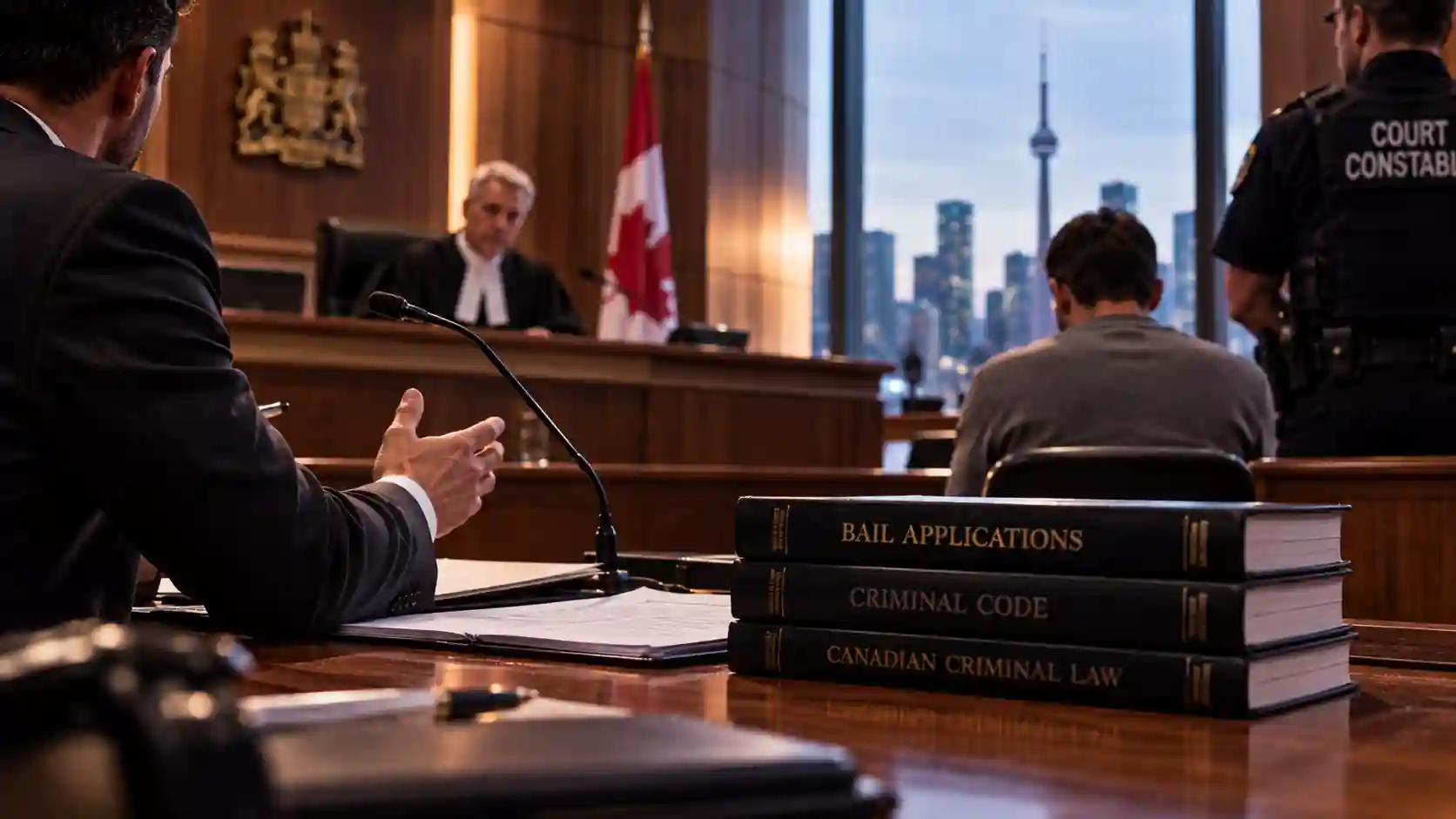
A photorealistic cinematic courtroom scene representing a Canadian bail hearing in Toronto. A criminal defence lawyer sits at the counsel table with legal documents in the foreground, while a judge and court official appear in the background. Warm wood tones, soft natural window light, and the Toronto skyline with the CN Tower create a professional and serious atmosphere. The composition visually communicates legal representation, bail applications, and the importance of timely criminal defence.

Understanding the Offence

What Bail Hearings Mean Under Canadian Law

Under section 515 of the Criminal Code of Canada, an accused person charged with an offence generally has a right to release unless the prosecutor establishes why detention is justified or why another form of release should be ordered. The law recognizes different grounds on which detention may be considered, including ensuring attendance in court, protecting public safety, and maintaining confidence in the administration of justice.

A bail hearing is therefore not a trial and does not determine whether an accused person is guilty or innocent. The issue is whether the person should be released pending the resolution of the criminal case and, if released, what conditions are appropriate. Depending on the circumstances, the court may consider an undertaking, release order, surety, supervision, reporting requirements, no-contact conditions, geographic restrictions, curfews, or other conditions.

A cinematic, photorealistic Canadian courtroom scene depicting the seriousness of a bail hearing. A person sits quietly beside their lawyer in the foreground while counsel addresses the judge from across the courtroom. Rich dark wood, legal documents, microphones, warm courtroom lighting, and a Canadian flag create an authentic judicial setting, with shallow depth of field and subdued navy and warm-gold tones conveying a professional and serious atmosphere.

Bail Hearings Toronto | Allegations

What a Bail Hearing Allegation Can Involve

The circumstances surrounding a bail hearing depend heavily on the underlying criminal charge. Bail applications can arise following allegations involving assault, domestic assault, sexual assault, criminal harassment, drug offences, firearms and weapons charges, robbery, theft, impaired driving, fraud, proceeds of crime, and other criminal offences.

The Crown may rely on the allegations, the accused's criminal record if applicable, previous release orders, alleged breaches, outstanding charges, and other relevant information. The defence may respond by presenting a practical bail plan, information about employment and residence, proposed sureties, supervision arrangements, treatment or counselling plans where relevant, and conditions designed to address identified concerns. Ontario's current bail practice direction provides for focused materials and submissions, with the Crown's bail package generally provided to defence counsel in advance.

How We Defend Bail Hearing Allegations

A bail hearing requires more than simply asking the court to release an accused person. The defence should understand the Crown's position, identify the applicable legal onus, and develop a release proposal that directly addresses the issues raised by the prosecution.

Defence Approach

Challenging the Need for Detention

Where the Crown seeks detention, the defence can address the specific ground or grounds relied upon. Section 515 recognizes primary, secondary, and tertiary grounds, concerning attendance in court, public safety, and confidence in the administration of justice. The appropriate response depends on the allegations, criminal history, circumstances, and proposed release plan.

Saggi Law Firm office in Brampton, Ontario
★Est. 2013 · Brampton, ON

“A direct 24/7 line, personal attention, and a strategy built around your case — not a template.”

— Mandeep Saggi

Building the Defence

Building an Effective Bail Defence Strategy

Every bail application should be prepared around the circumstances of the accused person and the concerns identified by the Crown. A focused strategy can help the court understand why a proposed release plan is workable and how any legitimate concerns can be addressed through appropriate conditions.

  • Legal Onus — whether the Crown bears the applicable onus or whether a reverse onus applies to the particular bail hearing.
  • Release Plan — whether the proposed residence, supervision, employment, surety, and conditions adequately address the concerns identified by the Crown.
  • Court Attendance — whether the accused has a realistic plan for attending every required court appearance and complying with release requirements.
  • Public Safety — whether proposed conditions can reasonably address any concerns relating to safety, witnesses, complainants, or alleged reoffending.

Meet the Lawyer

Meet the Lawyer

Your legal matter deserves personal attention from a qualified legal professional. Mandeep Saggi represents clients through Saggi Law Firm in serious criminal matters and provides focused criminal defence representation.

Mandeep Saggi, Criminal Defence Lawyer at Saggi Law Firm in Brampton, serving Toronto and the GTA
★★★★★ Top-Rated in Brampton

Barrister & Solicitor

Mandeep Saggi

Criminal Defence Lawyer

Strategy. Advocacy. Experience.

“Since 2013, Mandeep Saggi has built a reputation as a criminal defence lawyer in Brampton who vigorously fights for his clients' rights.”

He has successfully defended clients against criminal cases in the Ontario Court of Justice and the Superior Court of Justice, and makes daily appearances at the Brampton Courthouse.

Mandeep has been involved in high-profile criminal cases and represents clients in matters ranging from smaller-scale to complex criminal charges. Known for speedy responses, he keeps a direct line available 24/7.

§

Called to the Ontario Bar

Law Society of Ontario — 2013

§

Bachelor of Laws (LL.B Hons.)

University of Leicester, UK — 2009

§

Bachelor of Arts (B.A.)

York University — 2007

§

Articling

Toronto criminal law firm

§

Languages

English, Portuguese, Spanish, Punjabi, Hindi, Urdu

★Rated in the top 3 by Three Best Rated® — Best Criminal Defence Lawyers in Brampton

Protect Your Rights

Protect Your Rights in a Bail Hearing Case

If you have been arrested and are being held in police custody, decisions made before and during the bail hearing can have immediate consequences. The Ontario Court of Justice states that an accused person has a constitutional right to reasonable bail and a timely bail hearing. Where police do not release an accused person, they normally must be brought before a court for a bail hearing within 24 hours if a judge or justice of the peace is available.

Our criminal defence lawyer can assist with matters such as:

  • Bail applications and judicial interim release
  • Contested bail hearings
  • Consent releases and release orders
  • Surety hearings and surety preparation
  • Reverse onus bail hearings
  • Bail conditions and release plans
  • No-contact and stay-away conditions
  • Curfew, reporting, and geographic restrictions
  • Bail reviews and detention reviews
  • Breaches of bail or release conditions

After You Are Charged

What Happens After You Are Charged?

If police do not release an accused person following an arrest, the person remains in custody until appearing before a judge or justice of the peace for a bail hearing. The Ontario Court of Justice explains that a bail hearing determines whether the accused should be released pending trial or continue to be detained. The accused may be represented by their own lawyer or by duty counsel.

At the hearing, the Crown will indicate whether it consents to release or seeks detention. The defence presents its position concerning the appropriate form of release and proposed conditions. If the court orders release, the accused must comply with every condition in the release order and attend future court appearances. If detention is ordered, the accused remains in custody unless the detention is later changed through an applicable review process.

Why Early Legal Representation Matters

Bail hearings can move quickly, particularly when someone is being held in custody. Speaking with a bail lawyer before the hearing can allow time to understand the allegations, obtain relevant information, contact potential sureties, develop a release plan, and respond to the Crown's position.

Early legal representation can also help avoid unnecessary or unrealistic bail conditions. The objective is not simply to propose as many conditions as possible, but to present a release plan that is practical, enforceable, and responsive to the issues before the court.

Why Early Legal Representation Matters

Long-Term Consequences

Bail conditions can affect everyday life while a criminal case is pending. Conditions may restrict contact with certain people, travel, residence, communication, employment activities, possession of weapons, or other conduct depending on the circumstances.

Failure to comply with a release order can lead to serious consequences, including arrest and additional criminal allegations. The Ontario Court of Justice specifically warns that failing to obey conditions can result in being taken back into custody and potentially facing another criminal offence.

Individual Defence Strategy

A bail defence should be based on the actual circumstances of the accused. Someone facing a first offence may have different considerations from someone with previous convictions, outstanding charges, previous release orders, or alleged breaches.

A Toronto bail lawyer can examine the Crown's position and develop a release proposal addressing the applicable legal grounds. The plan may include a proposed surety, stable residence, employment information, reporting arrangements, treatment supports, or other appropriate conditions.

Empty Canadian courtroom where criminal trials and bail hearings take place

Criminal Justice Process

Understanding the Criminal Justice Process

The bail process generally begins after an arrest when the police either release the accused person or keep them in custody. If the accused remains detained, the person proceeds to a bail hearing, formally known as a judicial interim release hearing. In Ontario, bail hearings are heard by judges or justices of the peace with the appropriate jurisdiction.

At the hearing, the parties address the applicable onus and the Crown's position concerning detention or release. The Ontario Court of Justice's current practice direction requires parties at the beginning of a bail hearing to identify the onus, Crown position, detention grounds at issue, proposed form of release, defence position, and proposed release plan.

Bail hearings can be contested or proceed by consent. For contested hearings, the court may consider focused documentary materials and oral submissions. Ontario's current practice direction states that routine contested bail hearings are expected to be completed within 30 minutes in many cases, subject to the judicial officer's discretion, while consent releases are expected to be completed within 15 minutes. Complex matters can receive additional court time.

Frequently Asked Questions

Frequently Asked Questions About Bail Hearings

Understanding what happens during a bail hearing can make the process easier to navigate. Here are answers to common questions about bail applications, release conditions, sureties, detention, and bail reviews.

What is a bail hearing?

A bail hearing is a court proceeding that determines whether an accused person held in custody should be released while the criminal case continues. In Canada, it is also called a judicial interim release hearing. The court considers the applicable legal grounds, the Crown's position, the defence proposal, and any appropriate release conditions.

How long after arrest is a bail hearing?

In Ontario, if police continue to hold an accused person after arrest, the person must normally be brought before a judge or justice of the peace for a bail hearing within 24 hours when one is available. If one is unavailable, the hearing must occur as soon as possible. Weekend and holiday bail courts also operate.

Do I need a lawyer for a bail hearing?

An accused person may be represented by their own criminal lawyer or by duty counsel. Having a lawyer can be important because bail proceedings involve legal rules concerning release, detention, onus, evidence, and conditions. Defence counsel can also help prepare a release plan and address the Crown's specific concerns.

What is a surety in a bail hearing?

A surety is a person who agrees to supervise an accused person and help ensure compliance with release conditions and court attendance. The court considers whether surety release is necessary in the circumstances. Ontario's current practice direction states that surety release should only be required where it is the least onerous appropriate form of release.

Can bail be denied?

Yes. Under section 515 of the Criminal Code, detention can be ordered where the applicable legal requirements for detention are established. The recognized grounds include ensuring attendance in court, protecting public safety, and maintaining confidence in the administration of justice. Certain circumstances also create a reverse onus requiring the accused to show why detention is not justified.

What happens if bail is granted?

If release is ordered, the accused must comply with every condition in the release order and attend required court appearances. Conditions can include reporting, curfews, no-contact provisions, geographic restrictions, supervision, or other requirements. Breaching conditions can result in arrest, detention, and potentially additional criminal charges.

Can bail conditions be changed?

Bail or release conditions can sometimes be changed through the appropriate legal procedure. Ontario's Court of Justice provides procedures for certain consent variations of release orders and police undertakings. Whether a condition can be changed depends on the nature of the condition, the parties' positions, and the applicable procedure.

What happens if bail is denied?

If the court orders detention, the accused remains in custody while the criminal matter continues unless the detention order is subsequently changed. Depending on the circumstances, a bail review or other available legal procedure may be pursued. A lawyer can explain whether a review is appropriate and what evidence or legal basis may support it.

Visit Our Office

Saggi Law Firm — Brampton, ON

Located at Springdale Village Centre in Brampton. Available 24/7 for urgent legal matters — call, WhatsApp, or drop by the office.

Contact Us

Speak With Saggi Law Firm About Your Bail Hearing Case

If you or someone close to you has been arrested and is being held in custody, obtaining legal advice promptly can help you understand the next steps. Saggi Law Firm provides criminal defence representation for bail hearings in Toronto and the Greater Toronto Area, including contested bail applications, surety hearings, release plans, and bail-related applications.

The focus of a bail defence is to present the court with relevant information and a practical release proposal while addressing the Crown's concerns. Whether the underlying allegation involves assault, domestic violence, drug offences, firearms, robbery, fraud, impaired driving, criminal harassment, or another criminal charge, the circumstances of the proposed release matter.

Speak with Saggi Law Firm today about your bail hearing and discuss your available legal options.

+1 647-983-6720