★★★★★Bail Hearings Toronto | Lawyer · Criminal Defence

Saggi Law Firm — Criminal Defence

Statutory Declaration Services in Toronto | Notary & Declaration Assistance

A statutory declaration is a formal written statement in which a person solemnly declares that certain facts are true. It may be required for immigration applications, government matters, common-law relationships, insurance claims, business transactions, property matters, family documentation, or other legal and administrative purposes. Saggi Law Firm provides assistance with statutory declarations, affidavits, witnessing, commissioner services, and related notary requirements.

Need to make a statutory declaration today? Get assistance with the document and execution requirements before you sign.

Practicing Since2013
Availability24/7
ConsultationFree

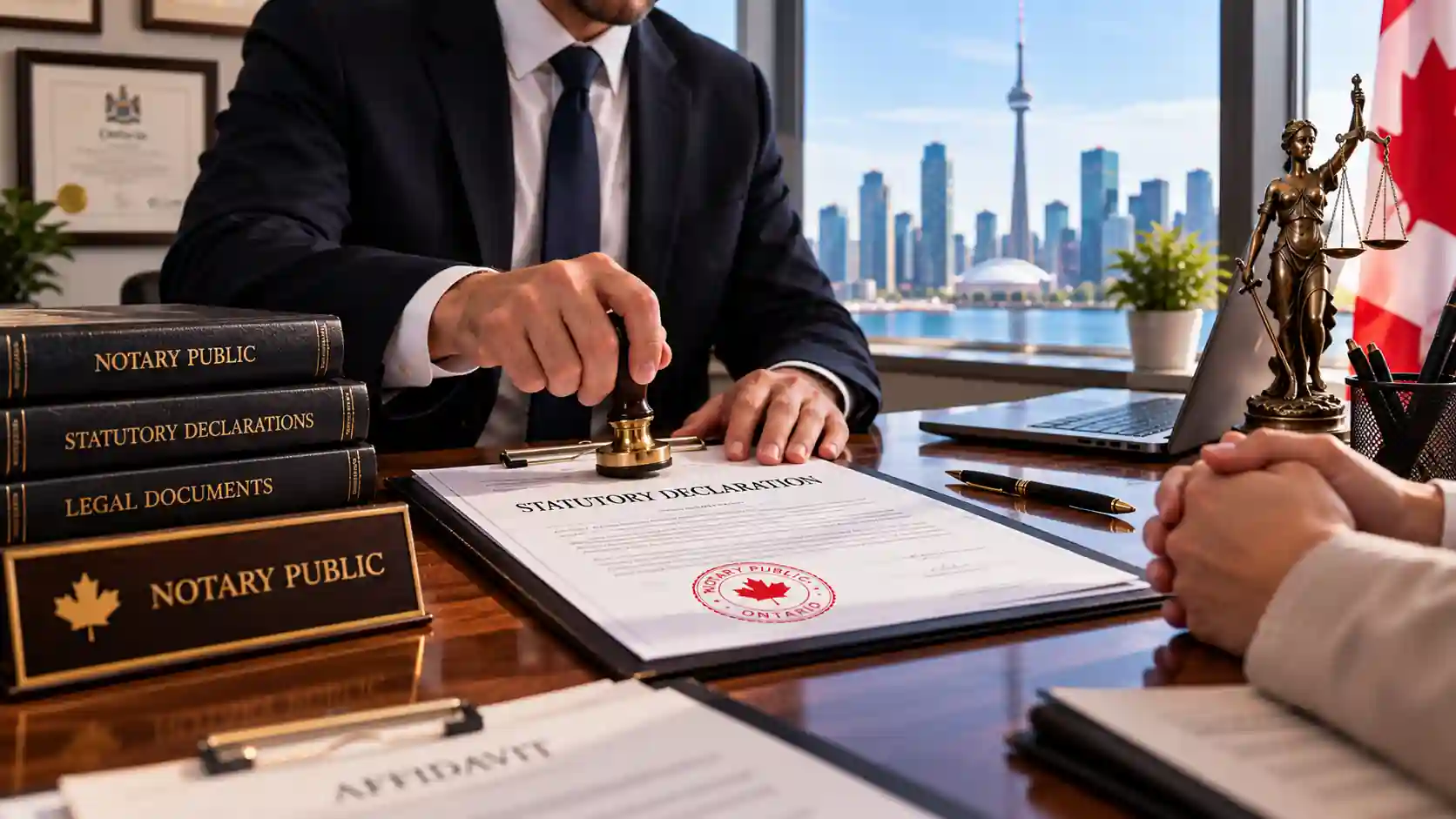
A professional, photorealistic Toronto notary office scene focused on statutory declaration services. A legal professional is formally stamping a Statutory Declaration document while a client sits across the desk. Legal books, a notary seal, affidavit documents, certificates, and a Notary Public plaque reinforce the document-services context. The Toronto skyline and CN Tower appear through the window, with warm natural lighting and polished wood creating a trustworthy, premium legal atmosphere suitable for a Statutory Declaration Services in Toronto | Notary & Declaration Assistance webpage.

Overview

What a Statutory Declaration Means Under Canadian Law

A statutory declaration is a legal document used to formally confirm facts or a written account. Section 41 of the Canada Evidence Act permits an authorized person, including a notary public or commissioner authorized to take affidavits, to receive a solemn declaration concerning the truth of facts or an account rendered in writing. The declaration is made voluntarily and has the same force and effect as if made under oath.

Ontario also specifically addresses solemn declarations under section 43 of the Evidence Act. The statutory form provides that the declarant solemnly declares the stated facts and conscientiously believes them to be true, with the declaration having the same force and effect as if made under oath. This is why a statutory declaration should be treated as a formal legal document rather than an ordinary written statement.

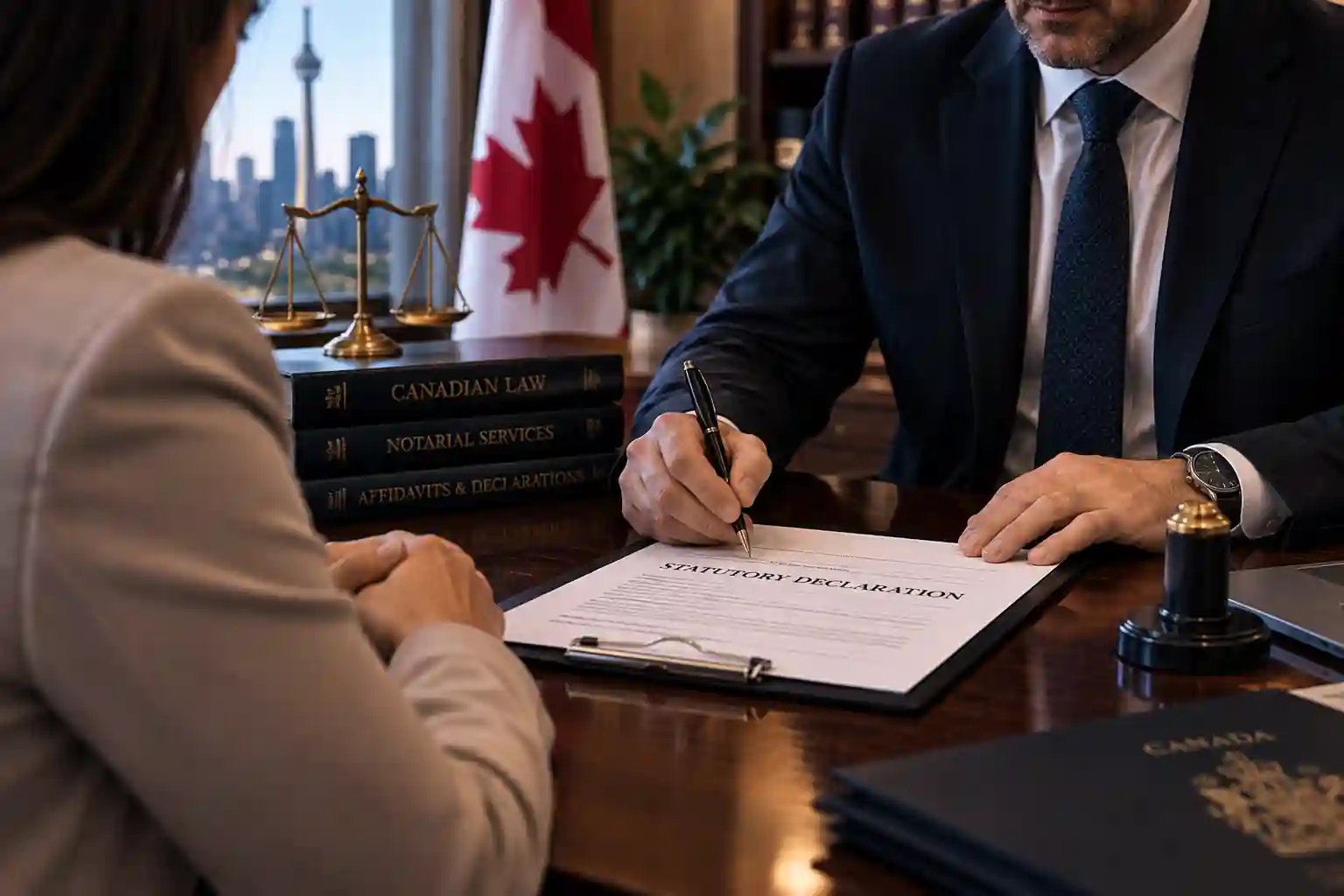
A cinematic, photorealistic legal office scene showing a person formally signing a statutory declaration before a legal professional. The document rests on a polished dark-wood desk alongside a notarial seal, pen, legal folders, and Canadian legal materials. A Canadian flag, scales of justice, law books, and a softly blurred Toronto-style skyline in the background reinforce the Canadian legal setting. Warm antique-gold lighting and deep navy shadows create a professional, serious, and trustworthy atmosphere.

What It Involves

What a Statutory Declaration Can Involve

The purpose of a statutory declaration depends on the organization, authority, or individual requesting it. A declaration may confirm a common-law relationship, identity, residency, employment information, ownership, loss of a document, family circumstances, business facts, or another specific statement of fact.

Some organizations provide their own statutory declaration form or declaration form with prescribed wording. Others may accept a declaration prepared specifically for the circumstances. Before signing, it is important to understand exactly what you are declaring and whether supporting documents, identification, or additional certification are required.

How We Help

Witnessing and Administering the Declaration

In Ontario, lawyers and paralegals are automatically commissioners for taking affidavits by virtue of office. Commissioners can administer oaths, affirmations, and declarations where permitted by law. A notary public has commissioner powers and can also perform additional notarial functions, including verifying signatures and certifying true copies where authorized.

Completing the Execution Requirements

The execution stage can involve confirming identity, witnessing the signature, administering the required solemn declaration, and completing the appropriate jurat or declaration section. Ontario law requires the person administering an oath or declaration to satisfy themselves of the genuineness of the signature and administer the declaration according to law.

Saggi Law Firm office in Brampton, Ontario
★Est. 2013 · Brampton, ON

“A direct 24/7 line, personal attention, and a strategy built around your case — not a template.”

— Mandeep Saggi

Our Approach

Building an Effective Declaration Process

A straightforward process can help avoid preventable problems when a statutory declaration is required for an important application or transaction. The document should be accurate, properly executed, and suitable for the purpose for which it will be submitted.

  • Purpose — whether the declaration clearly confirms the specific facts requested by the organization or authority receiving it.
  • Accuracy — whether every statement is truthful, complete, and consistent with the information and documents available to you.
  • Execution — whether the declaration is signed and administered before a person who is legally authorized to administer it.
  • Submission — whether the completed document satisfies the recipient's requirements concerning forms, identification, signatures, seals, or supporting documents.

Meet the Lawyer

Meet the Lawyer

Your legal matter deserves personal attention from a qualified legal professional. Mandeep Saggi represents clients through Saggi Law Firm in serious criminal matters and provides focused criminal defence representation.

Mandeep Saggi, Criminal Defence Lawyer at Saggi Law Firm in Brampton, serving Toronto and the GTA
★★★★★ Top-Rated in Brampton

Barrister & Solicitor

Mandeep Saggi

Criminal Defence Lawyer

Strategy. Advocacy. Experience.

“Since 2013, Mandeep Saggi has built a reputation as a criminal defence lawyer in Brampton who vigorously fights for his clients' rights.”

He has successfully defended clients against criminal cases in the Ontario Court of Justice and the Superior Court of Justice, and makes daily appearances at the Brampton Courthouse.

Mandeep has been involved in high-profile criminal cases and represents clients in matters ranging from smaller-scale to complex criminal charges. Known for speedy responses, he keeps a direct line available 24/7.

§

Called to the Ontario Bar

Law Society of Ontario — 2013

§

Bachelor of Laws (LL.B Hons.)

University of Leicester, UK — 2009

§

Bachelor of Arts (B.A.)

York University — 2007

§

Articling

Toronto criminal law firm

§

Languages

English, Portuguese, Spanish, Punjabi, Hindi, Urdu

★Rated in the top 3 by Three Best Rated® — Best Criminal Defence Lawyers in Brampton

Your Rights and Options

Protect Your Rights When Making a Statutory Declaration

A statutory declaration carries legal significance because the declarant is formally confirming that the stated facts are true. You should therefore carefully review the contents before signing and should not declare something you do not honestly believe to be accurate. Ontario guidance recognizes that false statutory declarations can have legal consequences.

Our criminal defence lawyer can assist with matters such as:

  • Reviewing a statutory declaration before signing
  • Explaining statutory declarations and affidavits
  • Assisting with declaration wording where appropriate
  • Witnessing statutory declarations
  • Commissioner of oaths and declarations services
  • Notary public services
  • Reviewing identification and execution requirements
  • Statutory declarations concerning common-law relationships
  • Reviewing supporting documents
  • Explaining the legal significance of signing a declaration

What to Expect

What Happens After You Need a Statutory Declaration?

The process generally begins by identifying why the statutory declaration is required and who will receive it. If a government agency, employer, financial institution, court, immigration authority, or other organization supplied a particular form, its instructions should be reviewed carefully. Some recipients may require prescribed language or additional documentation.

Once the declaration is ready, the declarant appears before an authorized person to make the required declaration. Depending on the circumstances, this may involve a notary public, commissioner for taking affidavits, or another person authorized under applicable law. The person administering the declaration may verify identity and the genuineness of the signature before completing the relevant portion of the document.

Why Early Legal Assistance Matters

Obtaining assistance before signing can be particularly useful when a statutory declaration concerns an important legal, immigration, financial, family, or regulatory matter. The purpose is not simply to sign a document, but to understand the facts being declared and the formal requirements that apply.

Early assistance can also identify whether you have been asked for an affidavit, statutory declaration, notarized document, certified copy, or another form of documentation. A commissioner can administer a declaration, but the role of a commissioner does not generally include providing legal advice about the underlying document.

Why It Matters

Long-Term Consequences

A statutory declaration may become part of the records supporting an application, transaction, claim, or administrative decision. Because the document formally records a person's declaration of facts, inaccurate or misleading information can create problems later.

Ontario government guidance states that a person can be guilty of an offence for making a false statutory declaration, highlighting why the contents should be reviewed carefully before signing. A declarant should only make a solemn declaration when conscientiously believing the stated facts to be true.

Individual Declaration Strategy

Every statutory declaration has a different purpose. A statutory declaration of common-law union, for example, may require different information from a declaration concerning a lost document, employment matter, property issue, or government application.

Saggi Law Firm can help you identify the requirements relevant to your particular document and assist with the appropriate preparation or execution process. Where a declaration involves substantive legal issues, individualized legal advice may be appropriate before the document is signed.

Empty Canadian courtroom where criminal trials and bail hearings take place

The Process

Understanding the Statutory Declaration Process

The process begins with the facts you are being asked to confirm. A statutory declaration should contain a clear written statement of those facts and should follow any form or instructions supplied by the receiving organization. If a prescribed declaration form exists, using the correct version can help prevent avoidable submission issues.

The next stage is making the declaration before an authorized person. Ontario's Commissioners for Taking Affidavits Act gives commissioners the power to take declarations where declarations may be taken or required under Ontario law. The Ontario government also confirms that lawyers and paralegals are automatically commissioners for taking affidavits by virtue of office.

The final stage is submission or use of the completed document. Requirements can vary depending on whether the document is being used in Canada or outside Canada. If a foreign authority requires authentication, legalization, or an apostille, additional steps may apply beyond simply having the declaration witnessed. The receiving authority's requirements should therefore be confirmed before completing the document.

Frequently Asked Questions

Frequently Asked Questions About Statutory Declarations

These are some common questions about statutory declarations, affidavits, notary services, witnessing, and the declaration process in Ontario.

What is a statutory declaration?

A statutory declaration is a formal written statement in which a person solemnly declares that specified facts are true. Under section 41 of the Canada Evidence Act, an authorized person may receive such a declaration concerning facts or a written account. The declaration has the same force and effect as if made under oath.

What is the difference between an affidavit and a statutory declaration?

An affidavit is a written statement confirmed by oath or affirmation, while a statutory declaration is a solemn declaration of facts made under applicable legislation. Both are formal legal documents, but they are not interchangeable in every situation. The court, government agency, organization, or other recipient may specify which document is required.

Do I need a notary for a statutory declaration?

Not always. The appropriate person depends on the legislation and the requirements of the organization receiving the document. In Ontario, commissioners can administer declarations, while notaries have commissioner powers plus certain additional notarial functions. Always check whether the recipient specifically requires a notary public rather than a commissioner.

Can a lawyer witness a statutory declaration in Ontario?

Yes. Lawyers in Ontario are automatically commissioners for taking affidavits by virtue of office and can administer declarations where legally permitted. However, witnessing a declaration and providing legal advice about its contents are separate matters. If the declaration concerns significant legal rights or obligations, legal advice may be appropriate before signing.

Can I make a statutory declaration online?

Some declarations may be administered remotely where the applicable Ontario rules permit it and the prescribed conditions are satisfied. Ontario law allows remote administration in circumstances provided by regulation. However, the rules differ from ordinary in-person execution, and notarial services may have different requirements, so the specific document should be reviewed first.

What should I bring to a statutory declaration appointment?

You should generally bring the declaration or statutory declaration form, acceptable identification, and any supporting documents relevant to the facts being declared. Do not sign the document in advance unless you have specifically been instructed to do so. The authorized person may need to witness your signature and complete the execution section.

Can a statutory declaration contain a false statement?

A declarant should only make statements they honestly believe to be true. A statutory declaration is a formal document, and Ontario government guidance states that making a false statutory declaration can constitute an offence. If you are uncertain about a fact, obtain appropriate legal advice before signing instead of declaring something you cannot conscientiously confirm.

Can I use a statutory declaration outside Canada?

Potentially, but the requirements depend on the foreign authority and the purpose of the document. A document intended for use outside Canada may require additional authentication, legalization, or apostille procedures. The fact that a document has been commissioned or notarized does not automatically mean every foreign authority will accept it without further steps.

Visit Our Office

Saggi Law Firm — Brampton, ON

Located at Springdale Village Centre in Brampton. Available 24/7 for urgent legal matters — call, WhatsApp, or drop by the office.

Contact Us

Speak With Saggi Law Firm About Your Statutory Declaration

When you need a statutory declaration, the document should be prepared and executed according to the requirements that apply to its intended use. Saggi Law Firm can assist with statutory declarations, affidavits, commissioner services, notary requirements, document review, and related execution matters.

Whether you need a declaration for a common-law relationship, government application, business matter, immigration documentation, property issue, or another official purpose, getting the requirements right can help avoid unnecessary delays or rejection. We can review the document you have been asked to complete and explain the applicable execution process.

Contact Saggi Law Firm today to discuss your statutory declaration and arrange the appropriate assistance.

+1 647-983-6720