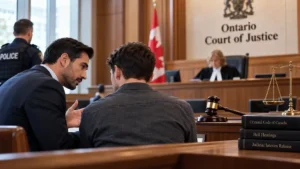

Assault is one of the most commonly charged criminal offences in Ontario. It ranges from a push or unwanted physical contact which can technically meet the Criminal Code definition to serious aggravated assault causing life-threatening injuries. Understanding what you are actually charged with, what the consequences are, and what defences may be available is the starting point for any informed decision about how to proceed.
This guide covers assault charges under the Criminal Code of Canada as they apply in Brampton and Ontario including the types of assault, mandatory and maximum penalties, how domestic assault cases are handled differently, and the defences that experienced assault lawyers use to challenge these charges.
What Is Assault Under the Criminal Code of Canada?
Assault in Canada is defined under s. 265 of the Criminal Code of Canada. A person commits assault when they:
- Apply force intentionally to another person, directly or indirectly, without that person’s consent
- Attempt or threaten, by an act or gesture, to apply force to another person, where the other person has reasonable grounds to believe that the accused has the ability to carry out the threat
- Accost, impede, or beg while openly wearing or carrying a weapon or imitation thereof
The definition is intentionally broad. Physical contact is not required a threat accompanied by a gesture capable of being carried out is sufficient. And the force applied can be slight – a shove, a slap, or even spitting on someone can form the basis of an assault charge in Ontario.
Types of Assault Charges in Ontario
Canadian criminal law creates several distinct assault offences, each carrying different maximum penalties depending on the severity of the act and its consequences.
Common Assault – s. 266
The least serious form of assault. Covers minor physical contact, threats, and gestures meeting the s. 265 definition where no weapon is used and no bodily harm results. Common assault is a hybrid offence, the Crown may elect to proceed by summary conviction or by indictment.
Maximum penalties:
- Summary conviction: up to 2 years less a day imprisonment
- Indictable: up to 5 years imprisonment
Assault with a Weapon or Causing Bodily Harm – s. 267
A more serious charge that applies where the accused either uses or carries a weapon during the assault, or causes bodily harm to the complainant. “Bodily harm” is defined under s. 2 of the Criminal Code as any hurt or injury that is not transient or trifling in nature.
Maximum penalties:
- Summary conviction: up to 18 months imprisonment
- Indictable: up to 10 years imprisonment
Aggravated Assault – s. 268
The most serious non-sexual assault offence. Aggravated assault occurs when the assault wounds, maims, disfigures, or endangers the life of the complainant. This is a straight indictable offence.
Maximum penalty: 14 years imprisonment
Assault of a Peace Officer – s. 270
Assaulting a police officer, peace officer, or other public official in the execution of their duties. Treated more seriously than common assault due to the protected status of the victim.
Maximum penalty: 5 years imprisonment (indictable)
Sexual Assault – s. 271 to s. 273
Sexual assault is governed by separate provisions carrying significantly different penalties and procedural rules. These charges are outside the scope of this guide but are handled by Saggi Law Firm.

Assault Penalties in Ontario – Summary Table
| Offence | Maximum Penalty (Summary) | Maximum Penalty (Indictable) |
|---|---|---|
| Common Assault (s. 266) | 2 years less a day | 5 years |
| Assault with Weapon / Causing Bodily Harm (s. 267) | 18 months | 10 years |
| Aggravated Assault (s. 268) | N/A – indictable only | 14 years |
| Assault of Peace Officer (s. 270) | 18 months | 5 years |
In addition to imprisonment, a court may impose:
- Probation with conditions (no-contact orders, counselling, community service)
- A fine
- A weapons prohibition under s. 109 or s. 110 of the Criminal Code
- Restitution to the complainant
A conviction for any assault offence results in a permanent criminal record visible to employers, professional licensing bodies, and border services agencies.
Domestic Assault – A Different Process in Ontario
Domestic assault charges in Brampton are handled differently from other assault matters and require specific attention from the outset.
Automatic No-Contact Conditions
In virtually every domestic assault arrest in Ontario, the accused is released with a no-contact order either by police or at a bail hearing prohibiting any contact with the complainant. In many cases, this means the accused cannot return to their own home, cannot communicate with their spouse or partner, and cannot see their children while the matter is before the courts.
These conditions can be in place for months or years while the case proceeds. An experienced assault lawyer in Brampton can move promptly to vary unreasonable conditions through a bail variation application.
Crown Policy on Domestic Violence Cases
The Crown Attorney’s office in Ontario follows specific domestic violence guidelines that direct Crown counsel to proceed with prosecution even where the complainant does not wish to proceed or recants their original statement to police. This means that a complainant’s change of heart while potentially relevant does not automatically result in the charge being withdrawn.
Understanding Crown policy on domestic matters is essential context for any discussion of resolution options. What works in a non-domestic assault case may not apply in a domestic context.
Impact on Family Proceedings
A domestic assault charge in Brampton frequently intersects with family law proceedings particularly where children are involved or where a custody or access dispute is already underway. The existence of criminal charges and the conditions attached to bail can directly affect access arrangements and family court proceedings. Legal advice on both the criminal and family dimensions is strongly recommended.
What Happens After an Assault Arrest in Brampton?
Arrest and Police Release
Most people charged with common assault in Ontario are released by police on an Undertaking or Promise to Appear, with conditions. In more serious matters including aggravated assault, assault causing bodily harm, or domestic assault a formal bail hearing before a justice of the peace may be required. For a complete explanation of what a bail hearing involves, see our bail hearing guide.
First Appearance at Brampton Courthouse
The first court appearance is typically administrative. No plea is entered and no evidence is heard. This is the stage at which Crown disclosure is requested the complete package of evidence the Crown intends to rely upon, including police notes, complainant statements, 911 recordings, and any surveillance or body camera footage.
Disclosure Review
A thorough review of Crown disclosure is the foundation of every assault defence. The review identifies: inconsistencies in the complainant’s account across statements; whether the accused’s version of events is supported or contradicted by independent evidence; whether police followed proper procedures; and whether any Charter issues arise from the investigation or arrest.
Resolution or Trial
The majority of assault charges in Brampton resolve before trial through Crown withdrawal, a peace bond under s. 810 of the Criminal Code, diversion (for first-time offenders), or a negotiated guilty plea to a lesser charge. Where none of these outcomes is appropriate or available, the matter proceeds to a contested hearing or trial.
Defences to Assault Charges in Ontario
Self-Defence – s. 34
Under s. 34 of the Criminal Code, a person is not criminally responsible for using force to defend themselves or another person if they believe on reasonable grounds that force is being used or threatened against them, and their response is reasonable in the circumstances. Self-defence is an objective-subjective test, the court considers both what the accused believed and whether that belief and response were reasonable.
Consent
Consent is a complete defence to assault under s. 265(3). Where both parties voluntarily engaged in an altercation for example, a consensual fight consent may be raised as a defence. However, consent has specific limits under the Criminal Code: it cannot be used as a defence where the assault causes bodily harm and there was a reasonable risk of harm.
Absence of Intent
Assault requires a wilful and intentional application of force. Accidental contact however serious the injury does not meet the criminal standard. Where the force was truly accidental and there is no evidence of intent, the essential element of the offence is absent.
Complainant Credibility
In many assault cases, the Crown’s case rests almost entirely on the complainant’s account. Where that account is inconsistent across multiple statements, contradicted by independent evidence, or undermined by the complainant’s own conduct or motivations, cross-examination of the complainant at trial is one of the most powerful tools available to the defence.
Charter Violations
If police conducted an unlawful search, failed to advise the accused of their right to counsel under s. 10(b) of the Canadian Charter of Rights and Freedoms, or obtained a statement in breach of the accused’s rights, a Charter application may result in the exclusion of evidence and the withdrawal or dismissal of the charge.
Can Assault Charges Be Withdrawn in Ontario?
Yes and this is a more realistic outcome than many people appreciate. Assault charges may be withdrawn by the Crown at any stage of the proceedings where:
- There is no reasonable prospect of conviction. For example, where the complainant is not a reliable witness, where independent evidence contradicts the Crown’s case, or where there are significant credibility issues
- Prosecution is not in the public interest particularly relevant for first-time offenders and minor incidents
- The matter is diverted through a community program available in appropriate cases for first-time offenders where the Crown agrees
- A peace bond is entered the accused agrees to keep the peace and have no contact with the complainant for a fixed period, in exchange for the charge being withdrawn
The availability of these outcomes depends heavily on the specific facts of the case, the Crown’s assessment of the evidence, and how the file has been managed from the outset. An assault lawyer in Brampton who reviews disclosure early, identifies weaknesses in the Crown’s case, and presents a clear resolution proposal has significantly better prospects of securing a withdrawal than one who waits for a trial date.
Frequently Asked Questions – Assault Charges Brampton
Can I be charged with assault if I didn’t hit anyone?
Yes. Under s. 265 of the Criminal Code, assault includes threatening, by act or gesture, to apply force where the other person has reasonable grounds to believe you can carry it out. A raised fist, a verbal threat accompanied by a step toward the complainant, or any gesture that creates reasonable apprehension of force can constitute assault no physical contact is required.
What if the complainant doesn’t want to press charges?
In Ontario, the decision to prosecute is made by the Crown Attorney, not the complainant. The complainant cannot “drop charges”, the Crown may proceed even if the complainant recants or declines to participate. However, a complainant’s unwillingness to testify or their changed account can affect the Crown’s assessment of whether there is a reasonable prospect of conviction.
Will I go to jail for a first-time assault charge in Ontario?
For a first-time common assault with no aggravating factors, imprisonment is possible but not common. Non-custodial sentences including a conditional discharge, a suspended sentence with probation, or a fine are frequently available for first-time offenders. However, this depends significantly on the nature of the alleged assault, the complainant’s position, and whether a prior record exists.
How long does an assault case take in Brampton?
Most assault matters at the Ontario Court of Justice in Brampton resolve within 6 to 18 months. Cases proceeding to trial take longer, particularly where Charter applications are involved. The timeline depends on disclosure volume, court scheduling, and whether resolution discussions are productive.
How much does an assault lawyer cost in Brampton?
The cost of an assault lawyer in Brampton depends on the seriousness of the charge and whether the matter proceeds to trial. For a detailed breakdown of criminal lawyer fees in Ontario including retainers, flat fees, and payment plans. See our complete 2026 cost guide.
Charged With Assault in Brampton? Contact Saggi Law Firm
Assault charges in Brampton can range from a minor incident with a realistic path to withdrawal, to a serious indictable matter requiring full trial preparation. Whatever the circumstances, the decisions made in the first days after an arrest about what to say, who to speak to, and when to retain a lawyer have a direct impact on outcomes.
Saggi Law Firm offers a free, confidential consultation 24 hours a day, 7 days a week. Mandeep Saggi will review the charge, explain the realistic range of outcomes, and advise you on next steps before you commit to anything.
For clients in Brampton and across the GTA looking for an assault lawyer near me or a law firm near Brampton with experience in assault defence, contact us now.
Call 647-983-6720 — available 24/7.
Mandeep Saggi is a criminal defence lawyer in Brampton, Ontario, called to the Ontario Bar in 2009 and a member in good standing of the Law Society of Ontario. He practises exclusively in criminal law and has defended assault charges at Brampton Courthouse and across the GTA for over 15 years.